
One Seven · Products
Foaming agent
The exceptional, constant and always reproducible bubble structure of One Seven® foam is the result of a perfect interaction between the chemical properties of One Seven® foaming agent and the One Seven® foam generator. Precisely and reliably adjusted proportioning rates in the systems guarantee an optimal extinguishing and cooling effect of the One Seven® foam. This results in unique extinguishing foams that differ significantly from conventional foam.
All One Seven® foaming agents were developed with the protection of people and the environment in mind. There is no risk of injury even in case of skin or eye contact with One Seven foam®. To protect the environment many One Seven® foaming agents do not use fluorine, without any loss of performance in firefighting.

One Seven · With us automatically optimal
The proportioning rate
The optimal proportioning of foaming agents is determined by the proportioning rate. It indicates the percentage of foaming agent which must be contained in the water/foaming agent solution. In the One Seven systems the proportioning rate is preset, automatically monitored during operation and automatically adjusted if necessary.
One Seven · Highly effective formula
One Seven foaming agent
One Seven foaming agent: Merciless against fire. Friendly to environment.
Contact persons
Comparison of fully and partially hydrated foaming agents
Many modern fire engines are equipped with highly efficient, but also sensitive, electronic proportioning systems. These systems rely on the foam concentrate having precisely the physical parameters defined during system testing. Any unforeseen increase in viscosity increases flow resistance and can lead to system failure in an emergency.
When semi-hydrated foam concentrates come into contact with (atmospheric) moisture, this triggers a gradual physicochemical process. This often drastically alters the flow behavior (viscosity) of the concentrate.
In industrial fire brigades, professional fire brigades, or industrial plants, this usually happens unnoticed over months or years, for example, through dome lids on vehicle tanks that are not completely airtight, through the ventilation nozzles of storage tanks, or during incomplete transfer.
However, as soon as the original container is opened and the foaming agent has thickened, the mixing system fails completely, and the product cannot be used in this way. An extreme situation that nobody wants.
Partially hydrated foaming agents, by definition, possess molecular chains (especially surfactants and polymers/thickeners) that are not completely saturated with water molecules. They have free, chemically highly active binding sites.
The effect: If humidity enters the tank, the concentrate becomes extremely hygroscopic: it literally attracts water from the air and binds it to the surface.
This causes the foaming agent to become continuously thicker and it can no longer be mixed in.
The proportioning system malfunctions due to insufficient or fluctuating dosage. No foam is produced, or the foam is of unusable quality. The firefighting attempt fails.
Do you know the actual flow behavior of your concentrate after years of storage?
Hydrated vs. Semi-Hydrated: Invisible differences with fatal consequences in an emergency. Viscosity guarantee: Why modern mixing systems demand consistent properties.
One Seven · Comparison of fully and partially hydrated foaming agents
If the flow behavior changes, the technology fails.
Foam concentrates are often stored for years in vehicle tanks or stationary systems. However, many conventional foam concentrates change their flow properties over time, often unnoticed.
The consequence: Modern, precise mixing systems cannot handle the more viscous concentrate. More precise dosing is required. In the worst case, the foam jet will collapse, exactly then, when it matters.
Fully hydrated foam concentrates
- Molecular structure
- The surfactant and polymer chains are completely and stably bound to water molecules.
- Flow behavior
- Constant and predictable: Exhibits stable, Newtonian, or slightly structure-viscous behavior.
- Storage Stability
- Excellent: No tendency toward separation, stratification, or drying out in the tank.
- Mixing Precision
- Maximum reliability: Consistent flow characteristics ensure that blending systems (e.g., CAFS) dispense with precision
- System Compatibility
- Ideal for modern, electronically controlled foam proportioning systems and CAFS systems.
Partially hydrated foam concentrates
- Molecular structure
- The chemical chains are only partially hydrated; free binding sites remain in the concentrate.
- Flow behavior
- Variable: Prone to significant changes in viscosity under shear stress or temperature fluctuations.
- Storage Stability
- Limited: Increased risk of phase separation, sludge formation, or scaling during long-term storage.
- Mixing Precision
- Risk: Thickening can cause pumps to jam or result in incorrect dosing rates (overdosing or underdosing).
- System Compatibility
- In modern gear pumps with tight tolerances, this can lead to error messages (e.g., flow errors).
One Seven · Hydrated vs. semi-hydrated
The chemical difference
Identical at first glance, but fundamentally different in behavior:
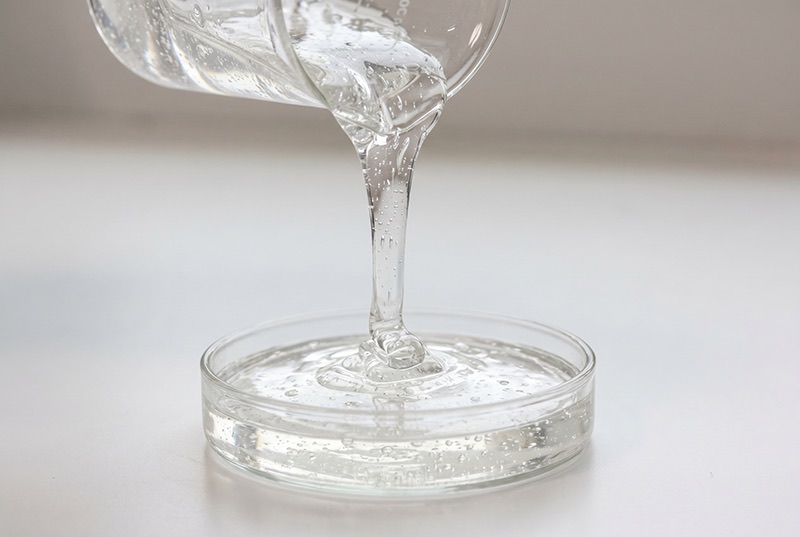 Hydrated foam concentrateHydrated foaming concentrate: Thanks to their thermodynamically stable composition, hydrated foam concentrates retain their optimal flow properties unchanged for years, thus guaranteeing precise mixing and absolute operational reliability at the crucial moment.
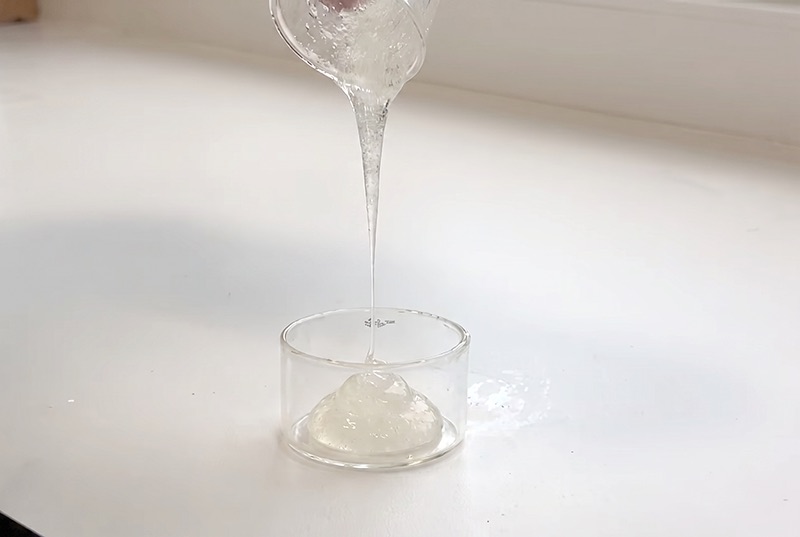 Semi-hydrated foam concentrateSemi-hydrated foam concentrate: Due to their chemical instability, semi-hydrated foaming agents tend to undergo unpredictable changes in flow behavior when in contact with moisture, which can block modern proportioning systems in an emergency and jeopardize critical operational readiness.
Security is not a matter of chance, but of systems engineering.
One Seven develops foam concentrate not as an isolated product, but as an integral component of a perfectly coordinated overall system. When foam concentrate and proportioning technology (CAFS) work hand in hand, we guarantee maximum reliability, superior extinguishing performance, and reproducible foam quality, from day one to year 25.
Choose your area